

The ability to read nutrition labels is a critical skill in making wise food choices. You’ll be better able to discern the healthier pick between similar brands and food types. Small, better choices made over a long timespan compound into transformative results.
Nutrition Label Components
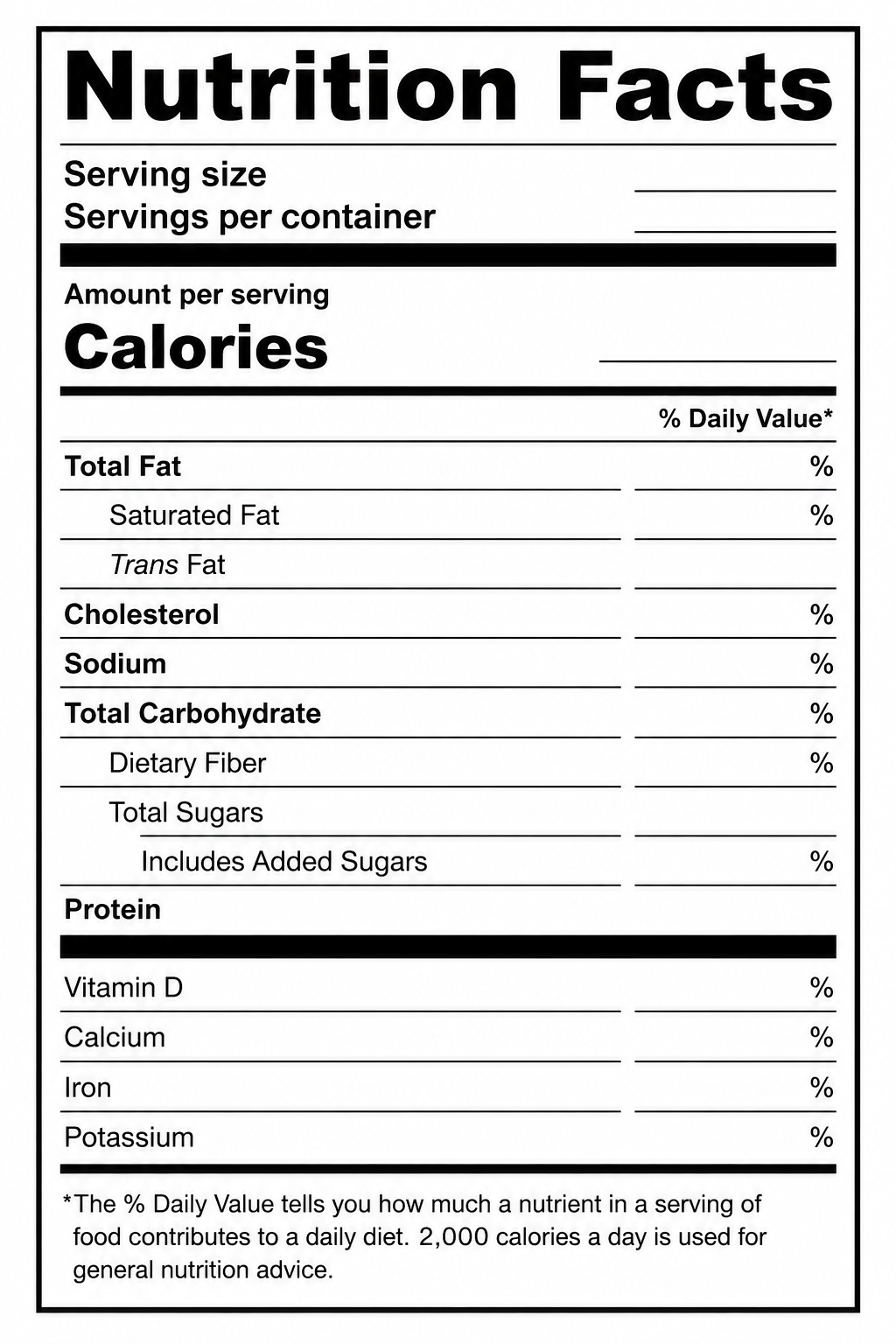
1) Serving Size
Displays how many grams or millilitres constitutes one serving. All of the nutrients below correspond to one serving size. If you eat two servings, double all nutrient intake. If you eat half a serving, divide all nutrients by 2.
It’s useful to have a food scale around to measure precisely how many servings you’re eating.
Servings/container displays how many total servings are contained within the entire package. I prefer buying my groceries in bulk wherever possible to extend the value of my money.
2) Calories
Displays how many calories are within a single serving. Calories come from the three essential macronutrients; carbs, fats, and proteins.
Calories represent energy. One calorie is the energy required to raise the temperature of one gram of water by one degree celsius. The Calories (capital C) we measure in food represent 1000 small calories. Food Calories are also represented as kcal (kilo calories), equivalent energy of increasing the temperature of a kilogram of water by one degree celsius.
Carbs and proteins both provide 4 kcals per gram, whereas dietary fat provides 9 kcals per gram. Alcohol is the only other energy providing dietary source providing 7 kcals per gram, though it does more harm for your body than good. Best to abstain from alcohol. Focusing on carbs, proteins, and fats are much cleaner.
3) Macronutrients (Fat, Carbs, Protein, and Sodium)
Dietary fat has the sub-categories of saturated, unsaturated, and trans fat. Unsaturated fats are the best. They lower LDL cholesterol (the harmful kind of cholesterol), improve heart health, and are required for brain, muscle, and blood-clotting function.
Saturated fats should be limited as they raise LDL cholesterol which can clog your arteries and increase risk of heart attacks/strokes.
Trans fats are to be avoided entirely as on top of raising LDL cholesterol, they lower HDL cholesterol (the beneficial cholesterol). These negative effects compound to further increase risk of heart attacks, strokes, and type 2 diabetes, therefore trans fats are avoided entirely.
Carbohydrates have the sub-categories of dietary fiber, total sugar, and added sugar. Dietary fiber is good. Fiber is indigestible material that helps move food along the digestive tract. It promotes regular bowel movements, takes out excess cholesterol as it passes through your system, and slows digestion so sugar gets absorbed into the bloodstream at a steady state. It also helps you feel fuller longer.
Men under 50 should get 38 grams of fiber/day, then 30 grams/day after 50. Women under 50 should get 25 grams of fiber/day, then 21 grams/day after 50.
Total sugars account for both natural sugars and added sugars. Natural sugars are found in fruits, vegetables, and dairy. They often bring forth greater nutritional value overall as natural sugar sources also bring along many vitamins, minerals, fibers, and proteins.
Added sugars are added into the food product through processing, preparation, and manufacturing methods. Common examples include table sugar, brown sugar, corn syrup, glucose, fructose, honey, maple syrup, and molasses. Even though honey and maple syrup are natural sweeteners, they’re still classified as added sugars.
Added sugars are problematic as they can easily be consumed copiously without contributing to overall satiety or offering much nutritional value. An apple-flavoured candy only gives sugar. whereas eating an apple gives many beneficial compounds on top of the natural sugars.
Therefore, when looking at nutritional labels, go for the products that have the least amount of added sugars.
Proteins provide amino acids which the body then uses to create enzymes, hormones, antibodies, and muscles. There are 20 amino acids we use to create these compounds, 9 of which are essential, meaning we cannot create them on our own and must obtain them through our diet.
Animal protein sources (meat, poultry, fish, eggs, and dairy) are complete protein sources; meaning they provide all 9 essential amino acids. Plant protein sources (beans, lentils, nuts, seeds, and whole grains) are incomplete protein sources; meaning they lack one or more essential amino acids (or have high amounts of certain essential amino acids more than others).
You need a variety of plant proteins sources for them to complement each other and provide a complete protein source together. Good combinations providing complete protein sources include rice with beans, whole grain bread with peanut butter, and pita with hummus.
There are a few standalone complete protein plant sources, including soy, quinoa, buckwheat, chia, amaranth, and hemp seeds.
With muscle-training, your body needs more protein to maintain and grow muscle. Active individuals need 1.2-2.2 grams of protein everyday per kilogram body weight. I train frequently, am building maximum muscle, and weigh 73 kg, so I would need 2.2 x 73 = 160.6 grams of protein a day to support muscle growth. You can also calculate your macronutrients here.
When reading nutrient labels, high protein foods are generally good, as long as their saturated fat, trans fat, and added sugars amounts are limited.
Sodium is included in the macronutrient section as you need large amounts of it daily for proper fluid balance, nerve signalling, and muscle function. Even though it’s not a macronutrient nor provide calories, it is an essential mineral that must be kept at optimal levels. Too little or too much leads to compromised health.
Sodium is contained in high amounts from processed meats, packaged snacks, fast food, restaurant food, frozen meals, cheese, canned soups, baked goods, sauces, and condiments. Because many western diets consume a lot of these food types, excess sodium leads to high blood pressure, heart disease, and stroke. Check for low-sodium alternative on the nutrition labels and flavour foods with herbs and spices instead of table salt to solve this.
If you’re like me and train a lot, sodium is lost quickly in sweat. If this lost sodium is not replenished, then the opposite problem needs to be solved. Sodium deficiency leads to fatigue, muscle cramps, confusion, brain fog, headaches, and nausea. Then salty snacks and electrolyte drinks are recommended to keep levels balanced. This is only for prolonged training sessions with profuse sweating on a regular basis.
4) Micronutrients
This section displays the amount of vitamins and minerals present in the food. Iron, calcium, potassium levels are required in Canada, with all other vitamins and minerals added in voluntarily (US labels also require vitamin D levels shown alongside iron, calcium, and potassium).
Foods are often fortified with micronutrients during processing to combat common deficiencies and/or boost the nutritional value of the food. They can make certain foods healthier but watch for high added sugars, saturated/trans fat, sodium, calories, or low fiber to better judge the food’s quality.
Whole foods (minimally processed foods. As close as possible from earth to table) are often naturally loaded with micronutrients. Fortified foods can complement the nutritional value whole foods provide.
5) % Daily Value
The right-hand side column displays how much of a nutrient one serving provides to a 2000 kcal daily diet. 5% or less is considered low and 15% or more is considered high. By comparing % daily value for specific nutrients, you can determine which food is better suited for your needs. However, not all nutrients have % daily value listed (e.g. proteins and total sugars). For these just compare grams instead. Get more of the good micronutrients, fibers, and proteins while limit the harmful excess sodium, saturated/trans fats, and added sugars.
6) Ingredient List
The ingredient list is technically not a part of the nutrition label though is usually nearby and knowing it is useful for making wide food choices. It shows you what the food is actually made of.
Ingredients are listed in descending order by weight. The ingredient used the most is listed first, then the second most-used, and so on. Generally the shorter the ingredient list, the less processed the food. The first 3-5 items make up the majority of the food.
Here are a few lists to watch out for in your ingredients:
Watch out for added sugars hidden in the ingredients. They have many names:
- Sugar
- Sucrose
- Glucose
- Dextrose
- Fructose
- Corn syrup
- Glucose syrup
- Maltose
- Brown sugar
- Honey
- Agave syrup
- Maple syrup
Sometimes companies split up sugar sources to lower them on the ingredient list. Very sneaky. If a sugar source is high on the ingredient list, it’s substantial.
Processed foods may use cheap filler fats without much nutritional value:
- Palm oil
- Palm Kernel Oil
- Partially hydrogenated oils (these are always trans fats)
- high amounts of soybean, canola, or vegetable oil in processed snacks
Some foods still contain trans fats even if not listed in nutrition label because the amount is below 0.5 grams, rounding down to 0.
Sodium sources come from more sources than simply ‘table salt’, including:
- Sodium nitrate/nitrite in cured meats
- sodium benzoate
- monosodium glutamate
- sodium phosphate
Not inherently unhealthy nor healthy. The nutrition label adds all these sources up so you can determine if you need more or less sodium according to your lifestyle.
Ingredient lists also include allergens, as well as fortified vitamins and minerals. Micronutrient fortification can be beneficial and if you’re allergic to something, check beforehand.
Quick Scans in the Grocery Aisle
As you walk down the grocery aisle or shop online for your groceries, it is useful to do a quick 30 second scan of the nutrition label/ingredient list before adding the item to your cart. Skim through each of the components we just went through, flagging down anything excessive and promoting healthy options. The first 3-5 ingredients will give you a good grasp of what the food is made of.
New regulations in Canada now include a magnifying glass symbol in the front of the package if it contains high amounts (more than 15% daily value) of saturated fats, added sugar, or sodium. These new regulations serve as warning signs to go for better alternatives.
What matters most is overall context of your whole diet. How everything adds up illuminates precisely the quality of your nutrition. I weigh and track everything I eat with a food scale and nutrient tracking app. This way I know precisely if I’m meeting my nutrient requirements.
Conclusion
Understanding the components of a nutrition label and combining it with the knowledge of ingredient lists can equip you to choose the healthiest food options at your favourite grocery store. Choose the best ingredients to make meals hearty and healthy.
If you have specific questions regarding optimal nutrition, reach out at varshan@pandherpersonaltraining.ca. I’d be happy to help out.